Feed Your Face!
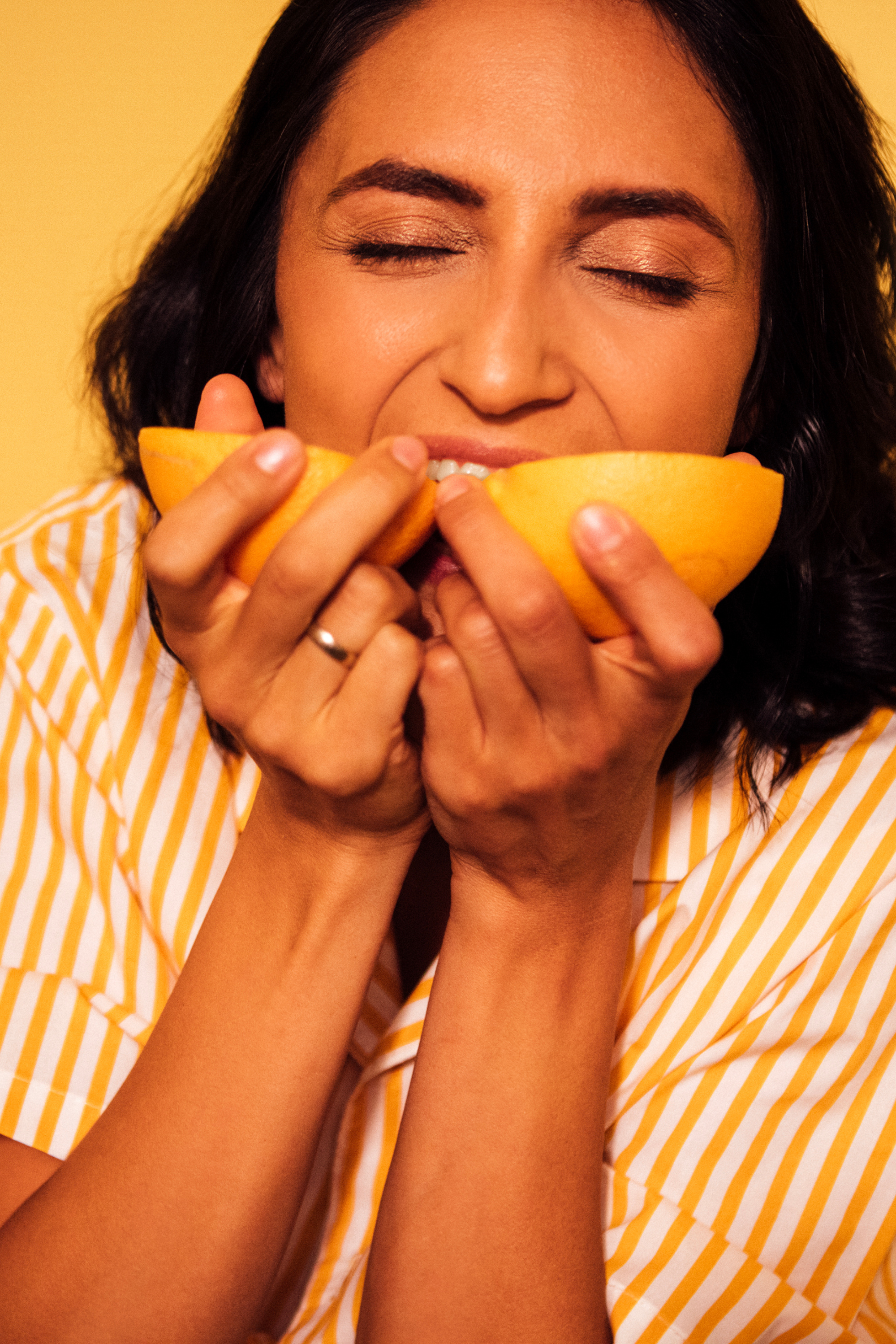
Nobody tells you that what you put in your mouth shows up on your face. Well — I'm telling you now.
I have spent a lot of time and money on what goes onto my skin. Cleansers, serums, SPF, retinol — all of it matters, and I've written about that elsewhere. But the honest truth is that the most significant shift in my skin happened when I started paying attention to what I was putting inside my body, not just on top of it. Your skin is the largest organ you have. It reflects everything — your sleep, your stress, your hormones, and absolutely your diet. Feed it well and it shows. Feed it poorly and that shows too.
So here is what I do. Not a plan, not a programme, not a detox — just how I actually eat, what I've cut out, what I swear by, and the one thing that might raise some eyebrows at the dinner table.
The Three Ingredient Rule
This is my non-negotiable. If a food has more than three ingredients, I'm not eating it. That's it. That's the rule. It sounds extreme until you realise how simple it makes every single food decision. You stop reading labels trying to decode chemical compounds you can't pronounce. You stop wondering whether something is 'clean' or not. Three ingredients or fewer — it either qualifies or it doesn't.
Processed food is one of the fastest routes to inflamed, dull, tired-looking skin. The preservatives, additives, refined sugars and seed oils in most packaged food create inflammation in the body that shows up directly on your face. I cut it out and within weeks my skin tone evened out and the puffiness I'd normalised simply disappeared. I hadn't even realised it was there until it was gone.
Let's talk about seed oils for a moment, because I feel strongly about this. Seed oils — rapeseed, sunflower, vegetable, soybean — are in almost every processed food on the shelf, and they have absolutely no business being inside a human body. Here is something that might make you put down your supermarket ready meal: seed oils were originally developed for industrial machinery. They were never intended for human consumption. Through a process of heavy refining, chemical extraction and deodorisation, they were eventually repurposed into something that got classified as food. I use that word loosely.
They are highly inflammatory, they oxidise easily when heated, and they disrupt the fatty acid balance your body needs to function properly — including the function of your skin. I genuinely would not be surprised if research in the next five years links seed oil consumption directly to cancer. The science on chronic inflammation and disease is already pointing in that direction. Cooking with seed oils is, in my opinion, not far off pouring engine oil into your body and expecting it to run cleanly. Swap them for olive oil, coconut oil, or butter from a good source. Your skin — and the rest of you — will notice the difference.
I also buy organic wherever possible. Not because I'm precious about it, but because the pesticide load on non-organic produce is real, and my skin noticed the difference when I made the switch. Your body is not a bin. Stop treating it like one.
Sardines. Yes, Really.
I know. I can already hear you. But hear me out before you close the tab.
Sardines are one of the most powerful skin foods on the planet and almost nobody is eating them because they smell like the bottom of a fishing boat and the tin is not exactly glamorous. But I am here to tell you, as someone who has tried approximately everything in the pursuit of good skin, that sardines are worth every raised eyebrow and every lingering kitchen smell.
They are loaded with omega-3 fatty acids, which reduce inflammation, keep the skin barrier strong and give you that lit-from-within glow that no serum has ever quite managed to replicate. They're also packed with vitamin D, calcium, and protein — all essential for skin health. And because they are small fish, they are low in mercury, which is more than can be said for a lot of other oily fish.
Are they glamorous? Absolutely not. Do I care? Not even slightly. My skin is on high rotation with sardines and I refuse to apologise for it. You can thank me later — preferably from a well-ventilated room.
Bone Broth: Collagen in a Cup
Bone broth is also on high rotation in my kitchen, and has been for years. As we age, our collagen production slows down — this is why skin loses its plumpness and elasticity over time. Bone broth is one of the most bioavailable sources of collagen you can get, meaning your body can actually use it rather than just pass it straight through.
I drink it, cook with it, add it to soups and sauces. It's become such a staple that I barely notice it anymore — which is probably the best thing you can say about any healthy habit. It stopped feeling like an effort and just became part of how I eat.
The Italian Food Rules (This Is Not Negotiable Either)
Yes, I eat pasta. Yes, I eat cheese. No, I am not giving them up and I will not be taking questions on this.
But — and this is the important part — my pasta and my cheese come from Italy. Italy has some of the strictest food production guidelines in the world. The pasta is made with durum wheat and nothing else. The Parmigiano Reggiano is exactly what it says it is. There are no additives, no fillers, no shortcuts. You are eating the actual thing, not a processed approximation of it.
There is a reason the Mediterranean diet is consistently ranked as one of the best in the world for health and longevity. Real food, quality ingredients, eaten with pleasure. I will take that over a beige diet of rice cakes and misery any day of the week.
Water, But Make It Filtered. And Glass.
I will only drink filtered water, and it has to be in glass. Not plastic. Not a plastic bottle with a motivational quote on the side. Glass.
Microplastics are showing up everywhere — in our food, our water, our bloodstream — and the research on what they do to the body long-term is not reassuring. Filtering your water removes a significant amount of the chlorine, heavy metals and contaminants that come out of the tap. Drinking from glass rather than plastic eliminates the risk of microplastics and hormone-disrupting chemicals leaching into what you're consuming. It is a small change with a meaningful impact, and once you make the switch you genuinely cannot go back.
Hydration is also one of the simplest and most overlooked tools for good skin. Dehydrated skin looks dull, feels tight, and shows lines more readily. Drink your water. In glass. Filtered. I said what I said.
Fruit, Vegetables, and the Mushroom Situation
I eat all fruits and vegetables. All of them. A wide variety of colourful produce gives your skin antioxidants, vitamins C and E, beta carotene and a whole host of phytonutrients that protect against the kind of cellular damage that accelerates ageing. Eat the rainbow, as they say — and they are right.
I will make one small confession here. Mushrooms. I know they are extraordinary for you — immune-boosting, anti-inflammatory, genuinely one of nature's most impressive foods. I know all of this. I have read all of this. And yet — the texture. I cannot get past the texture. It's a whole thing. I am working on it. We don't need to discuss it further.
The Vices
I am a coffee addict. I will not pretend otherwise. I have read all the articles about cortisol and skin and the optimal time to have your first cup, and I have filed them away politely and continued drinking my coffee. Life is about balance and coffee is non-negotiable. I draw the line at excessive amounts — and I make sure my water intake is solid to counteract the dehydration — but the coffee stays.
I have the occasional glass of wine. I smoked briefly in my 20s and 30s — I'm not going to pretend otherwise — but I stopped, and I'm glad I did. Smoking is, without question, one of the most destructive things you can do to your skin. It breaks down collagen, restricts blood flow and accelerates ageing in ways that no skincare routine can fully reverse. If there is one thing on this list that is genuinely non-negotiable for your skin, it's that one. The good news is that your skin begins to recover once you stop — it's not too late to undo some of the damage.
The Bottom Line
You do not need a complicated diet to have good skin. You need real food, quality ingredients, enough water and the willingness to occasionally smell of sardines in the pursuit of a good complexion. I consider that an entirely reasonable trade-off.
Your skin reflects your life. Feed it well, and it will show up for you. It really is that simple — even if simple doesn't always mean easy.
What are you eating — or not eating — for your skin? I'd love to hear what's working for you. Tell me in the comments. Sardine converts especially welcome.
T