Dressing Like Yourself Is an Act of Rebellion: Part 2 — Wear What You Want
About fifteen years ago a friend asked if I'd be a hair model for a hairdresser she knew who was doing a trial for a job. Free highlights, a fresh cut — I said yes immediately. Why wouldn't I?
The hairdresser was in her mid to late 20s. As we were chatting we realised I was the same age as her mum. I was in my mid 40s at the time — and I looked like I was in my mid 30s. Ageing didn't really kick in for me until after menopause. But I could see it happen in real time. The look on her face. The shift in her body language. She had clocked my age and made a decision about me before she'd even picked up the scissors.
The colour was fine. The cut was not great — if I'm honest. I was a little annoyed but I wasn't paying, so I said nothing. And then came the moment that has stayed with me ever since. When her work was being assessed, she smiled and said, proudly: "I gave her an age appropriate cut."
I was horrified. Not just at the cut — at the presumption. She had looked at me, decided what was suitable for a woman of my age, and delivered it without asking me a single thing about who I was, how I dressed, or how I wanted to feel walking out of that salon. Age appropriate. Two words that have followed me around ever since like a bad smell.
In Part 1, I talked about getting your style identity back — the mindset shift, the rebellion, the slow return to yourself after years of playing small or dressing for someone else. If you haven't read that one, go and read it first. This is Part 2. This is the practical bit. This is where we talk about actually dressing the body you have right now — not the body you had at 35, not the body you're hoping to have after the next diet — and doing it on your own terms, not anyone else's.
I Don't Subscribe to Generational Dressing
Two words that make me shudder from the inside out: age appropriate. I have a visceral physical reaction to that phrase. A full body recoil. Because what it really means — when you strip away the polite language — is: know your place. Stay in your lane. Stop taking up space you haven't been assigned.
No thank you.
Let me be clear about where I stand on this: I do not believe in age-appropriate dressing. I believe in you-appropriate dressing. There is a significant difference.
Age-appropriate is a concept invented to make women smaller. To take up less space, draw less attention, fade more gracefully into the background. It masquerades as good taste but what it actually is, is control. And I stopped letting it control me a long time ago.
I wear a lot of what women in their 20s are wearing right now because I like it, it suits me, and the idea that fashion has an expiry date stamped on it by someone else's opinion is frankly absurd. If you want to wear it, wear it. That's the whole rule. That's all of it.
The Women I Look To
My style icons are not 25-year-old models. They never have been. I look to women who have figured out who they are and dress accordingly — with confidence, with intention, with absolutely zero apology.
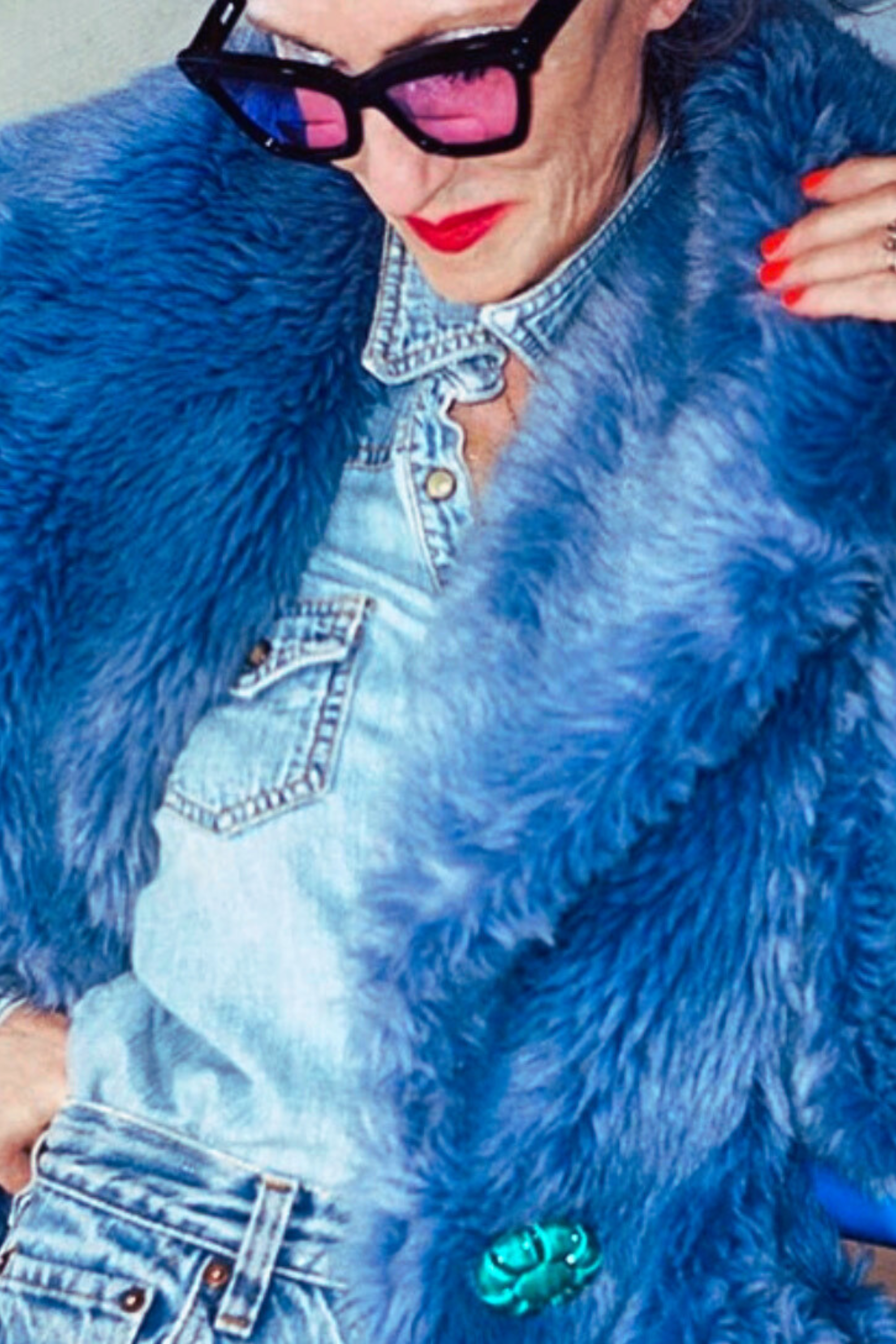
Linda Rodin is one of them. I discovered her about twenty years ago and she has been my style guru ever since. When I am stuck, when I open my wardrobe and feel completely uninspired, Linda is my first reference point. I ask myself what Linda would do and somehow it cuts right through the noise.
If you don't know her, stop what you are doing and look her up. Right now. I mean it.
What I love about Linda is the ease of it. Vintage Levi's with socks and sandals. Simple pieces worn with complete confidence and not a single thing to prove. Her style is elegant without being stiff, creative without being try-hard, unique without being costumey. It is utterly timeless — not because it follows classic rules, but because it is so completely and authentically her that trends simply don't touch it. That is the holy grail of personal style and she has had it for decades.
She is proof that the most stylish thing a woman can do is figure out who she is and dress like that person. No apology, no compromise, no looking over her shoulder to check if it's acceptable. Just herself, completely.
Vivienne Westwood was another — anarchic, fearless, dressing on her own terms until the very end, never once asking permission.
And then there is Iris Apfel. If Linda is my guru for effortless elegance, Iris is my reminder that dressing should be joyful. She piled on the jewellery, the colour, the layers, the unexpected combinations — not because she was making a statement, but because it made her happy. That was her only criteria. Not what was flattering, not what was appropriate, not what anyone else thought. What made her happy. She was still doing it in her 100s and she was magnificent.
These are not women who faded. These are women who got louder, bolder and more themselves with every passing year. That is not a coincidence. That is what happens when you stop dressing for other people and start dressing for yourself.
I also look to the streets. New York and Copenhagen are two cities where women dress with a confidence and individuality that I find genuinely inspiring. Not runway fashion — real women, real streets, real style. Women of all ages wearing what they love and looking extraordinary for it. That's the reference point I come back to. Not a magazine telling me what's flattering for my age. Actual women living their actual lives in clothes they actually chose.
Your Body Has Changed. So What.
Here is the conversation nobody wants to have honestly: yes, our bodies change after 50. Menopause redistributes weight. Things shift. The waist you had at 40 might look different now. This is real and it is worth acknowledging rather than pretending it isn't happening.
But here is what I refuse to do: use it as a reason to hide. The response to a changing body is not a bigger cardigan and a prayer. It's figuring out what works for the body you have right now and dressing that body with the same care and intention you'd give any other. Your body is not a problem to be solved. It is a body to be dressed.
For me that means knowing my formula. Baggy jeans, heeled boots, a vintage jacket. That's my uniform and I can build an entire wardrobe around it. It works for my shape, my life and my mood. I'm not reinventing myself every season — I'm refining. There's a difference, and it's a liberating one.
Letting Go of the Rules
No horizontal stripes after a certain size. No bright colours after a certain age. No short skirts after 50. No leather after 60. No, no, no, no, no.
I want you to take every single one of those rules and put them in a bag and leave them at the door. They were never yours to begin with. They were handed to you by a culture that is deeply uncomfortable with women taking up space and decided the most efficient way to manage that was to convince us to manage ourselves.
The only question worth asking when you get dressed is: do I love this? Does it feel like me? If the answer is yes — wear it. If the answer is no — don't. That's the entire framework. Everything else is noise.
Find Your Icons, Find Your Streets
If you're not sure where to start, start by looking at women whose style you admire. Not celebrities styled by a team of ten. Real women, women whose lives look something like yours, women who are dressing for themselves rather than for approval. Find your Linda Rodin. Follow accounts that show you street style from cities with strong individual fashion cultures. Get off the algorithm that keeps showing you the same beige capsule wardrobe and go looking for something that actually excites you.
Style is not something that happens to you. It's something you build, over time, through paying attention to what makes you feel like yourself and doing more of that. It evolves. It changes. At 60 I dress differently than I did at 40 — not because the rules said I should, but because I know myself better now. And knowing yourself better is one of the genuine gifts of getting older, if you're paying attention.
You are not too old for fashion. Fashion is too limited in its thinking for you. Dress accordingly.
Who are your style icons? I'd love to know in the comments — let's build a list of women who are doing it right and inspire each other. 💙